Photo: Topsy Page
Here are some great ways for additional adults to play an important role in philosophy sessions.
Facilitation & modelling
1. Facilitate P4C exercises, games and enquiries.
2. Model philosophical talk with the teacher, including questions. For example, What do you think? Why? How do you know?
3. Model philosophical language, for example I’m wondering if…, I’m not sure because… I disagree because…
4. Support or challenge children during pair or small-group discussions.
5. Support children to generate their own philosophical questions.
6. Help manage the practical aspects of the enquiry, so the teacher can focus on facilitating dialogue.
Participation & inclusion
7. Pre-teach key vocabulary and concepts, to help all children access the enquiry.
8. Monitor participation, for example using a talk tally.
9. Provide support where needed, for example visuals, translation apps, simplified language.
10. Support children who are not yet able to participate in the whole-class enquiry through 1:1 or small-group discussion.
11. Support children to focus and self-regulate.
Philosophical thinking & dialogue
12. Encourage children to build on, extend and challenge each other’s ideas.
13. Encourage children to justify their thinking and provide reasons or evidence.
14. Encourage respectful disagreement, helping children challenge ideas rather than individuals.
15. Celebrate philosophical thinking. Great reasons! I like how you made a distinction between… Well done for seeing another perspective.
Assessment & observation
16. Note-take / mind-map.
17. Notice when children show 4C thinking, and gather evidence.
Resources & environment
18. Record children’s philosophical questions, big ideas and quotes in P4C books or displays.
19. Help create and maintain P4C displays / working walls, and resources.
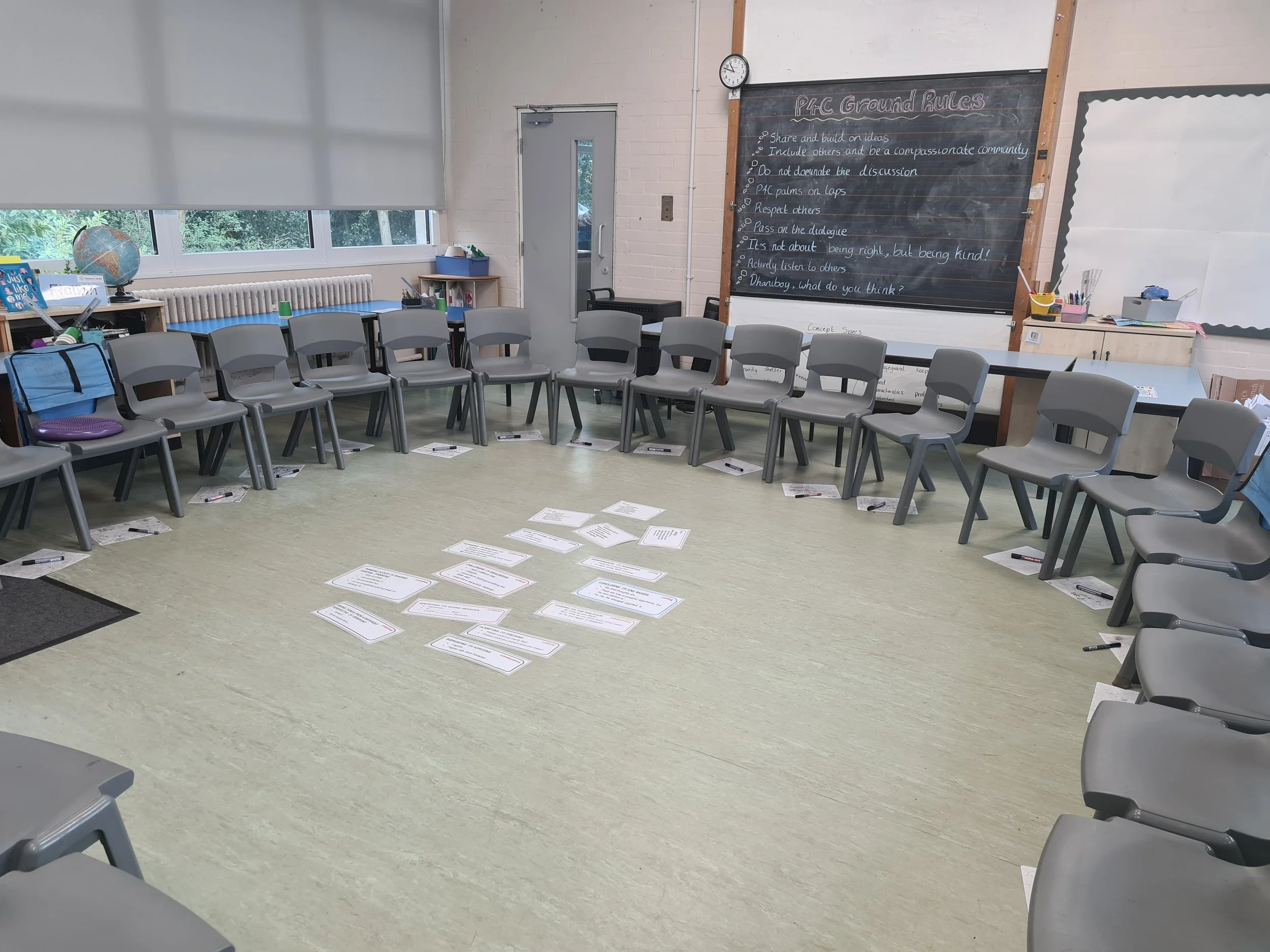
20. Support the development of a philosophical classroom environment where children feel safe to question, disagree, change their minds and share ideas.